


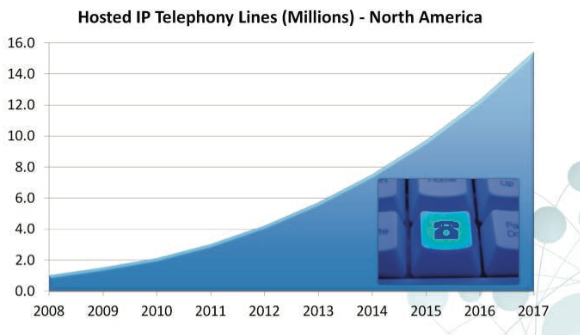
Hosted PBX has become increasingly popular for businesses of all sizes worldwide. In North America alone, Frost & Sullivan outlines the adoption from 1 million hosted IP telephony lines in 2008 to 15 million projected in 2017.
OnSIP specializes in combining enterprise-class PBX services, unified communications, and collaboration services. We bundle all of these components and deliver them through our own reliable cloud-based phone system infrastructure at an unbeatable price.

Reliability: OnSIP versus other hosted PBX services
When you purchase hosted PBX service from other providers, in many cases what you're really buying is space on an individual Asterisk server (or other IP PBX server) in a single datacenter. This service delivery model has several potential drawbacks for customers:
- In this model, it is in the best interest of the provider to oversubscribe the number of users on a particular piece of hardware, much like a shared server at a hosting provider, degrading quality and reliability
- Your PBX service may fail if the physical server you are installed on goes down
- Other customers on your assigned server can overwhelm the server and cause your service to fail
- Maintenance and upgrades, both planned and unplanned, can impact your continuity of service
- You may experience poor quality due to suboptimal call routing through the single location
The OnSIP hosted PBX platform was built on a completely different paradigm. The platform we built uses geographically distributed servers (patented) for every PBX feature we offer. We use geolocation to find the best route for your calls. For example, if you're physically located in New Jersey, your calls will be routed through our New York datacenter, but your coworker in Colorado would be routed through our datacenter in Los Angeles. All of our databases, servers, routers, and Internet connections are redundant to ensure that you are never physically tied down to any one piece of equipment.
With OnSIP hosted PBX, you are guaranteed:
- A completely scalable service. Technically, there is no difference between you adding 500 new users or 500 customers adding 1 user.
- Redundancy. All of our services are delivered across a farm of servers, routers and network components.
- Reliability. You will certainly never hear us tell you that someone else on your shared server caused a problem that has impacted your service. You can depend on OnSIP being one of the most reliable hosted VoIP services out there.

Pricing: OnSIP versus other cloud based phone systems
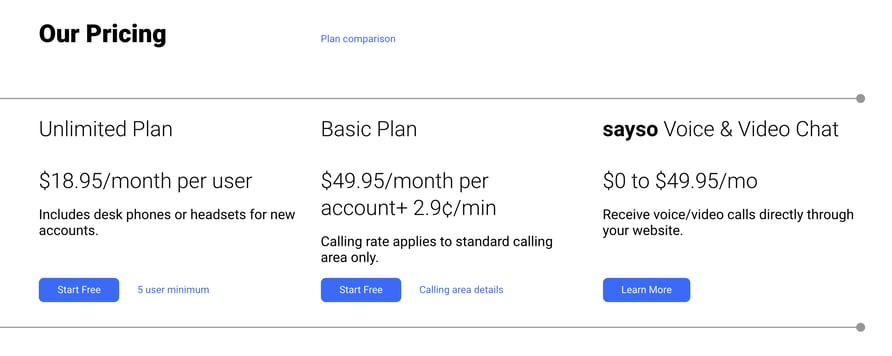
OnSIP has the most flexible pricing in the hosted PBX market, leading to extensive savings. Our Basic Plan enables companies to choose their features and pay for external calling as they go. On this unique plan, phones, users, and extensions are free, and customers only pay for what they use. Alternatively, our Unlimited Plan offers extensive savings to companies with medium to high phone usage.
Top Hosted PBX Features
OnSIP offers 50+ cloud based phone system and collaboration features. Here are some core features most businesses need:
|
|